

Introduction
Choose vs chose is one of the most commonly confused grammar topics in English. Many writers, students, and even fluent speakers struggle to determine when to use “choose” and when to use “chose.” Although the two words look similar, they serve different grammatical purposes and belong to different verb tenses.
Understanding the distinction between these words can dramatically improve your writing clarity and confidence. Whether you are preparing academic papers, writing professional emails, or improving your everyday English, mastering “choose vs chose” helps you communicate more accurately.
In this detailed guide, you will learn the exact difference between “choose” and “chose,” how each word functions in a sentence, common grammar mistakes, pronunciation tips, and practical examples that make the rules easy to remember.
What Does “Choose” Mean?
The word “choose” is a present tense verb that means to select, decide, or pick something from multiple options. It describes an action happening now or an action that regularly occurs. In English grammar, “choose” is the base form of the verb.
People use “choose” when discussing current decisions, future intentions, or repeated habits. For example, someone might say, “I choose healthy meals every day,” or “You can choose your favorite color.” In both cases, the action is happening in the present or refers to a general behavior.
One important reason learners confuse “choose vs chose” is because both words belong to the same verb family. However, “choose” specifically refers to actions in the present tense. It often appears with helping verbs such as “will,” “can,” “should,” and “may.”
Consider these examples:
- I choose honesty in difficult situations.
- They choose different routes to avoid traffic.
- You can choose whichever design you prefer.
- We will choose the final winner tomorrow.
In every sentence above, the action is either happening now or relates to the future.
Another useful way to understand “choose” is to associate it with active decision-making. The word often appears in conversations involving preferences, opportunities, and personal freedom. Businesses use it in marketing campaigns because it encourages empowerment and individuality. Phrases like “Choose your path” or “Choose excellence” are common because the word creates a strong sense of control and participation.

The pronunciation of “choose” is also important. It sounds like “chooz,” ending with a soft “z” sound. Correct pronunciation can help distinguish it from “chose,” which sounds slightly different.
What Does “Chose” Mean?
The word “chose” is the simple past tense form of “choose.” It refers to a decision or selection that already happened in the past. Whenever you describe an action completed earlier, “chose” is usually the correct word.
For example:
- She chose the blue dress yesterday.
- They chose a new manager last week.
- I chose to study abroad after graduation.
Each sentence refers to an action that has already been completed. The decision was made in the past, so “chose” is the correct form.
One of the easiest ways to remember the difference between “choose vs chose” is by focusing on time. If the action is happening now, use “choose.” If the action already happened, use “chose.”
Many English learners mistakenly write sentences like “Yesterday, I choose pizza for dinner.” This is grammatically incorrect because “yesterday” signals the past tense. The correct sentence is “Yesterday, I chose pizza for dinner.”
Another important detail is pronunciation. “Chose” rhymes with “goes” and “nose.” Unlike “choose,” it does not end with a buzzing “z” sound. Practicing the pronunciation aloud can improve both speaking and listening skills.
The word “chose” often appears in storytelling, historical writing, and personal narratives because these forms naturally discuss past events. For example:
- The company chose innovation over tradition.
- He chose silence during the argument.
- The teacher chose three students for the competition.
These examples demonstrate completed decisions from the past.
Understanding “chose” also helps learners improve sentence consistency. Switching accidentally between present and past tense can confuse readers and weaken professional writing. Mastering this distinction creates smoother and more polished communication.
Choose vs Chose: Key Differences Explained
The main difference between “choose vs chose” lies in verb tense. “Choose” is present tense, while “chose” is past tense. Although this rule sounds simple, many writers still misuse the words because they focus on spelling instead of grammar context.
Here is a quick comparison:
| Word | Verb Tense | Meaning |
|---|---|---|
| Choose | Present tense | To select now or regularly |
| Chose | Past tense | Selected in the past |
This grammatical distinction is essential because tense tells readers when an action occurred. Without correct tense usage, sentences may sound awkward or confusing.
For example:
- Correct: I choose my clothes carefully.
- Incorrect: I chose my clothes carefully every day.
The second sentence sounds strange because “every day” suggests a repeated present habit, not a completed past action.
Now compare these examples:
- Correct: Last night, we chose a movie to watch.
- Incorrect: Last night, we choose a movie to watch.
Because “last night” refers to the past, “chose” is required.
Another useful strategy for remembering “choose vs chose” is recognizing time indicators. Certain words often signal whether you need present or past tense.
Present tense clues:
- Today
- Usually
- Every day
- Now
- Tomorrow
Past tense clues:
- Yesterday
- Last week
- Earlier
- Previously
- In 2024
These context clues make grammar decisions easier and faster.
It is also helpful to understand the full verb forms:
- Choose (present)
- Chose (past)
- Chosen (past participle)
Many learners accidentally confuse “chose” and “chosen.” For example:
- Incorrect: I have chose a new laptop.
- Correct: I have chosen a new laptop.
The word “chosen” is used with helping verbs like “has,” “have,” or “had.” Meanwhile, “chose” works independently as the simple past tense.
Mastering these subtle differences improves grammar accuracy and boosts confidence in both speaking and writing.
Common Mistakes People Make With Choose and Chose
One major reason people struggle with “choose vs chose” is that English irregular verbs do not always follow predictable spelling patterns. Since “choose” changes to “chose” instead of adding “-ed,” learners often rely on guesswork.
A very common mistake involves mixing time references. Consider this sentence:
- Incorrect: I choose that option yesterday.
The word “yesterday” clearly signals past tense, so the correct sentence should be:
- Correct: I chose that option yesterday.
Another frequent mistake is using “chose” with modal verbs such as “can,” “should,” or “will.” For example:
- Incorrect: You should chose wisely.
- Correct: You should choose wisely.
After modal verbs, English grammar requires the base form of the verb, which is “choose.”
Confusion also appears in formal writing. Students sometimes shift tenses accidentally within the same paragraph. For example:
- Incorrect: The manager chose a strategy and then choose a marketing plan.
- Correct: The manager chose a strategy and then chose a marketing plan.
Maintaining tense consistency creates smoother and more professional writing.
Pronunciation issues can also contribute to spelling errors. Since “choose” and “chose” sound somewhat similar, learners may write the wrong word even when they understand the grammar rule. Reading and listening practice can help reduce these mistakes.
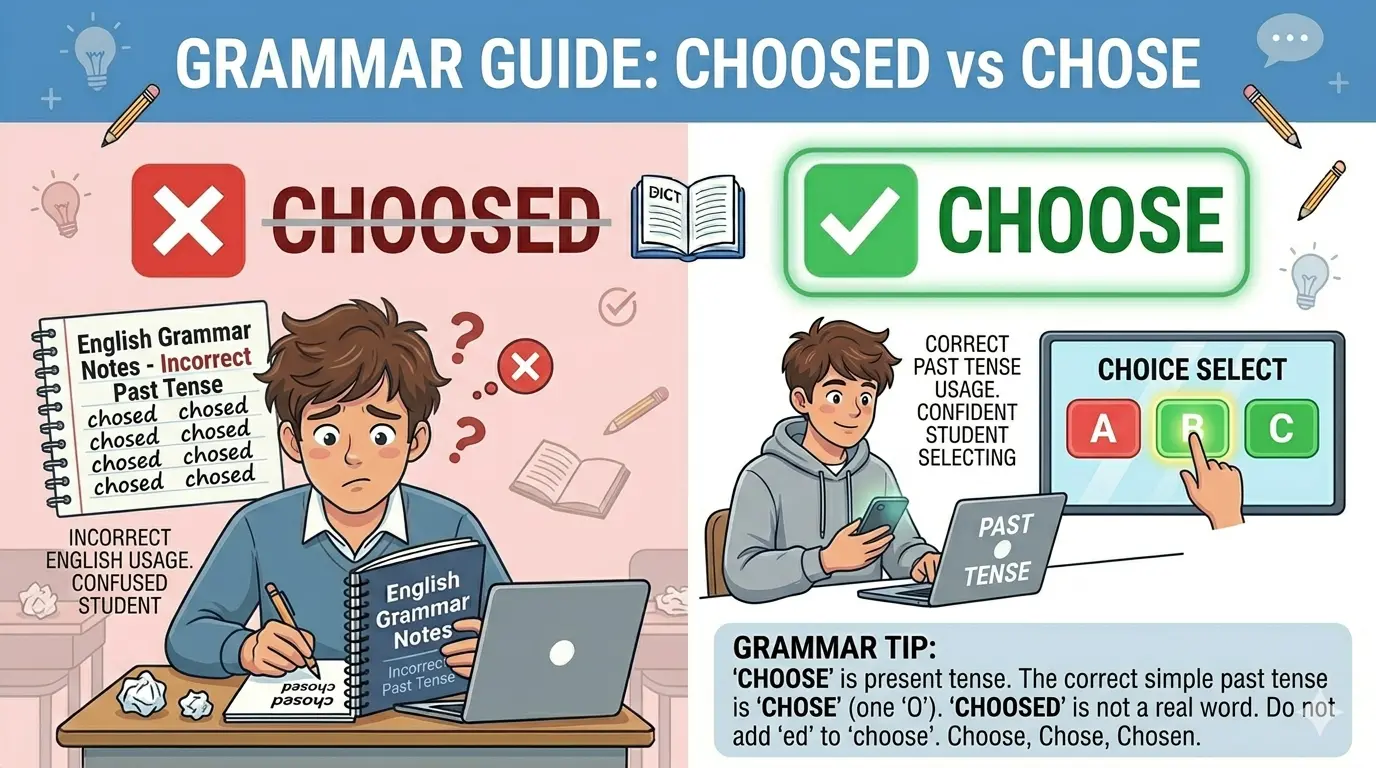
Another problem occurs when learners overthink irregular verbs. Some people incorrectly write “choosed,” assuming every past tense requires “-ed.” However, “choosed” is not a correct English word. The correct past tense is always “chose.”
Teachers often encourage students to memorize irregular verbs through repetition and sentence-building exercises. This method improves long-term retention and helps learners recognize patterns naturally.
One highly effective technique is creating personal examples:
- I choose healthy habits.
- Yesterday, I chose to exercise.
Practicing with real-life situations makes grammar easier to remember and apply.
Tips to Master Choose vs Chose in Everyday Writing
Improving your understanding of “choose vs chose” becomes easier when you practice consistently and use memory techniques. One of the best strategies is associating each word with a specific timeframe.
Think of it this way:
- Choose = happening now
- Chose = already happened
This simple mental shortcut can instantly improve grammar accuracy.
Reading English content regularly is another powerful learning method. Books, blogs, newspapers, and professional articles expose you to natural verb usage. Over time, your brain begins recognizing correct sentence structures automatically.
Writing practice is equally important. Try composing short sentences daily using both forms:
- I choose kindness.
- She chose a different career path.
This repetition strengthens your understanding and builds writing confidence.
Another useful tip is to check for time markers before selecting a verb. Ask yourself:
- Is the action happening now?
- Did the action happen earlier?
The answer will guide your choice between “choose” and “chose.”
Grammar apps and editing tools can also help identify mistakes. However, relying only on software may slow your learning process. Combining technology with active practice produces better long-term results.
Listening to native English speakers can improve both pronunciation and grammar recognition. Movies, podcasts, and interviews often include examples of these verbs in everyday conversation. Hearing the words used naturally helps reinforce correct usage.
Teachers frequently recommend reading sentences aloud. When spoken clearly, tense errors often become easier to notice. For example:
- “Yesterday, I choose pizza” sounds awkward when spoken.
- “Yesterday, I chose pizza” sounds natural.
Consistency is the key to mastering grammar. Small daily improvements eventually create strong communication skills. Whether you are a student, professional, or language learner, understanding “choose vs chose” will strengthen both your writing and speaking abilities.
FAQs About Choose vs Chose
1. What is the difference between choose and chose?
“Choose” is present tense, while “chose” is past tense.
2. Is “choose” present tense?
Yes, “choose” is the present tense form of the verb.
3. Is “chose” a real word?
Yes, “chose” is the correct past tense of “choose.”
4. Can I say “I have chose”?
No. The correct phrase is “I have chosen.”
5. What is the past participle of choose?
The past participle is “chosen.”
6. Why do people confuse choose and chose?
People confuse them because the words look and sound similar.
7. Is “choosed” correct English?
No. “Choosed” is incorrect. Use “chose” instead.
8. How can I remember choose vs chose?
Remember: “choose” happens now, while “chose” already happened.
9. Which word should I use with “yesterday”?
Use “chose” because “yesterday” refers to the past.
10. Can choose and chose be used interchangeably?
No. They represent different tenses and cannot be swapped freely.
Conclusion
Understanding the difference between choose vs chose is essential for accurate English grammar. While the words may look similar, they represent different verb tenses and serve different purposes in communication.
“Choose” is the present tense form used for current or future decisions, while “chose” is the past tense form used for decisions already made. Recognizing time indicators, practicing sentence construction, and reading regularly can help you avoid common mistakes.
Mastering these grammar basics improves writing clarity, professionalism, and confidence. Whether you are writing essays, emails, blog posts, or casual messages, using the correct verb tense ensures your ideas are communicated effectively.
