
Introduction
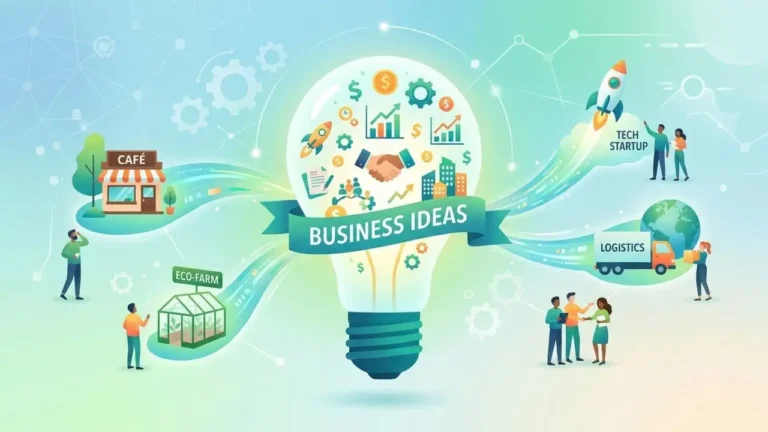
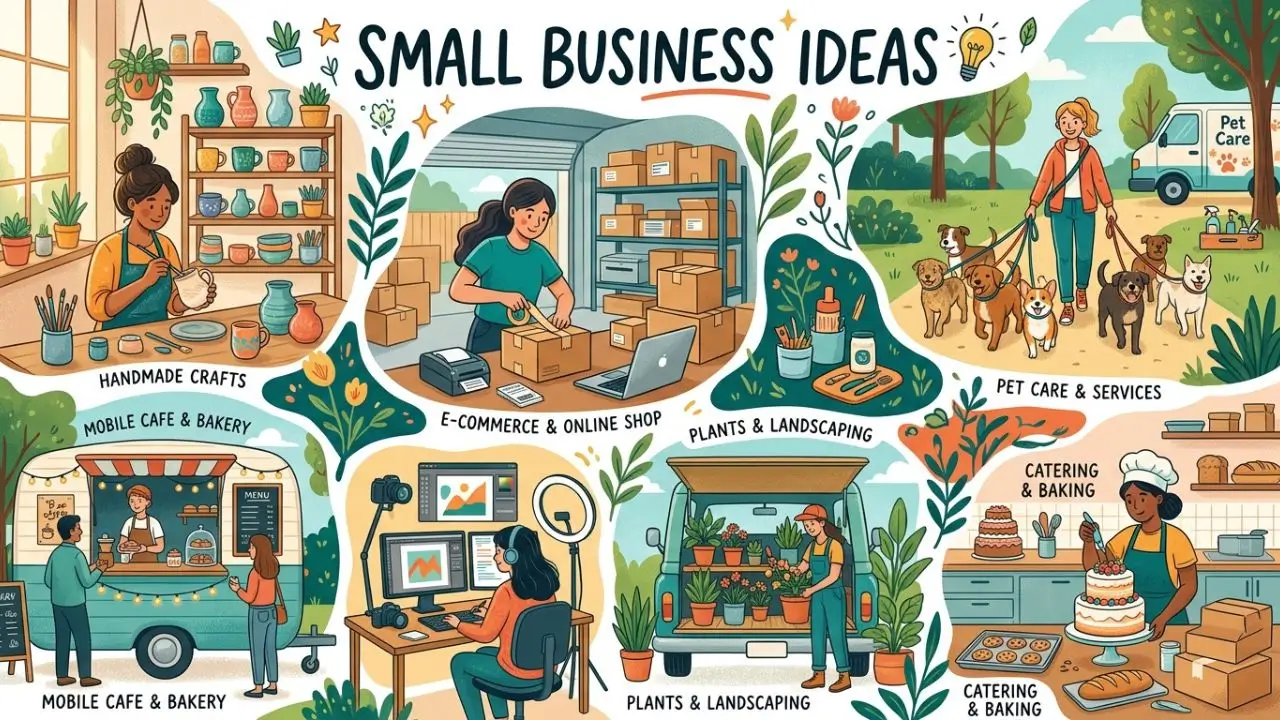
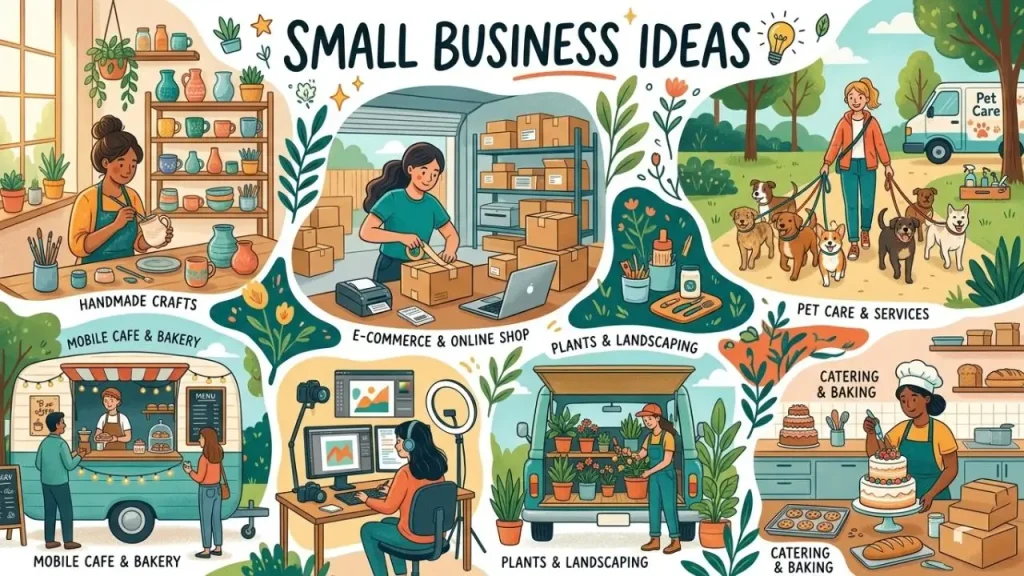
A good business idea doesn’t have to be spectacular. SuccessfulSmall Business Ideas often emerge from a simple, recurring problem that people face—and are willing to pay to solve. This is precisely where many small business ideas begin: with a skill, a personal interest, or a service that meets a genuine everyday need.
The great advantage of a small business lies in its flexibility. You don’t always need a large office, a large workforce, or significant capital investment. Some business models can be launched from home, while others are carried out directly at the customer’s location. What matters most isn’t how grand the idea looks on paper, but whether it aligns with your skills, your available budget, and the needs of your target audience.
If you would like to discover more practical business ideas, you can also check out our comprehensive guide to various business opportunities.
Anyone looking to start their own business shouldn’t simply choose the first idea that comes along. A sound decision starts with a few fundamental questions: What problem can I solve? Who would pay for it? What are the costs involved? Can I start small? And can the business be expanded later?
1. Services: An Easy Way to Start a Small Business
Service-based businesses are among the most attractive small business options because they can often be launched with relatively little capital. Instead of purchasing goods and building up inventory right away, you sell a skill or a specific service. Examples include cleaning, garden maintenance, minor repairs, tutoring, pet sitting, or assistance with daily tasks.
A major advantage is that customers usually grasp the value of a service immediately. A family with little time for housework might look for a cleaner. An elderly homeowner might need help maintaining their garden. Parents might be seeking a tutor for their child. Such needs don’t simply disappear, which is why a well-run local service business can build a loyal customer base.
Cleaning and Household Services
A cleaning service, for instance, is a business model that can be developed gradually. Initially, a single person can serve a few households, focusing on regular appointments. Later, additional staff can be hired or extra services offered—such as window cleaning or deep cleaning after a move.
Household services operate in a similar way. People often need assistance with shopping, organizing, tidying up, or other non-medical tasks. Reliability and trust play a particularly important role here. Punctuality, meticulous work, and professional customer interaction can help you stand out from many competitors.
2. Business Ideas for People with Special Skills

Not every small business needs to be based on manual labor or a physical storefront. If you possess a specific skill, you can turn it into a business model as well. Examples include writing, translation, graphic design, photography, programming, bookkeeping, tutoring, or technical consulting.
The key is to view a skill not merely as a “talent,” but as a concrete solution to a customer’s problem. A company might need help with invoicing. A local business might require professional product photos. A student might need math tutoring. A small business might want to have documents translated. The more clearly the problem can be defined, the easier it is to explain the service you offer.
The U.S. Small Business Administration recommends, among other things, carefully examining the market, target audience, competition, and potential costs before launching.
Tutoring and Instruction
Tutoring is a classic way to build a small business based on existing expertise. Subjects such as mathematics, English, and the sciences—as well as specific exam preparation—are often in high demand. Lessons can be conducted in person or online, depending on your resources and target audience.
Opportunities also exist outside the academic sphere. Language lessons, music instruction, basic computer training, or practical workshops can appeal to various age groups. One advantage is that satisfied clients often recommend your services to others. A strong personal rapport and visible progress on the part of the students are more important than a complex business structure.
Creative Services
Graphic design, photography, video editing, and writing can also form the basis of a small business. It is advisable to consider early on what type of clients you wish to serve. For instance, a photographer might focus on families, real estate, or corporate clients, while a designer could create logos, menus, or promotional materials for local businesses.
Clear specialization can simplify your work. Trying to offer everything to everyone means constantly having to meet new and varied demands. In contrast, a clearly defined service offering makes it easier for clients to understand exactly what they are getting and why the service is worth the price.
3. Product-Based Small Business Ideas
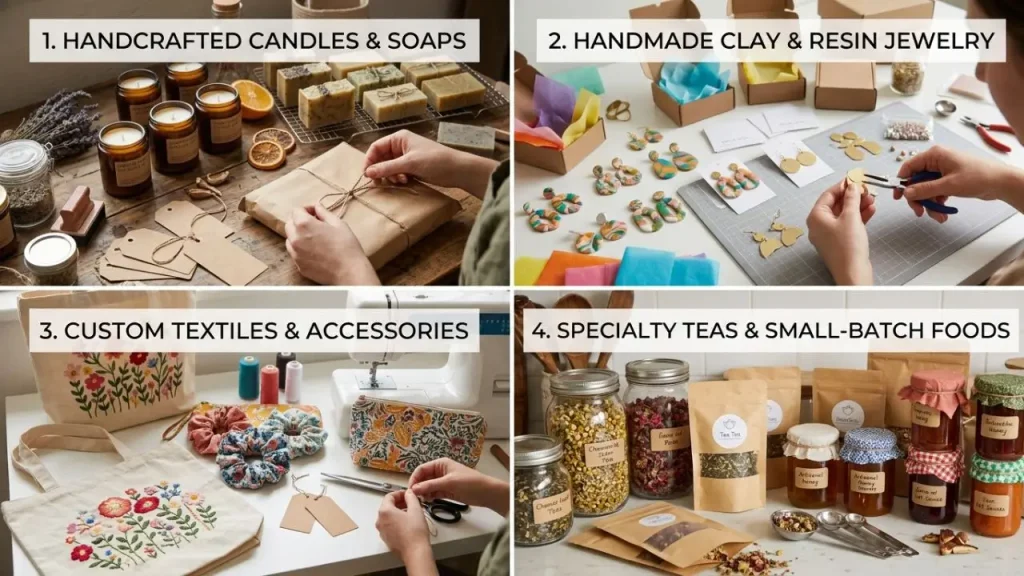
If you prefer selling products rather than services, there are numerous opportunities available. These include handmade goods, personalized gifts, specialty items for specific hobbies, baked goods, decorations, or curated products from a specific niche.
However, product-based businesses require more precise financial calculations. Materials, packaging, storage, shipping, returns, and damaged goods can drive up actual costs. A product that appears profitable at first glance may yield significantly lower profits once all expenses are deducted.
That is why it is advisable to test the waters on a small scale before making a major investment. Instead of manufacturing a hundred units of a product, you can produce a smaller batch and observe how customers respond. This allows you to determine whether the price, quality, and design truly appeal to buyers.
Personalized Products
Personalized products can be an attractive option because customers are often willing to pay a premium for something unique. Examples include printed mugs, personalized gift boxes, name tags, decorations, and custom-designed clothing.
Success in this area depends heavily on quality and reliability. A customer ordering a personalized gift for a specific occasion expects accurate lettering and timely delivery. Even minor errors can be particularly frustrating with such products; therefore, careful quality control and clear ordering processes are crucial.
Food and Specialty Products
If you enjoy baking or cooking, you might consider starting a small food business or a specialized catering service. Possibilities include cakes for special occasions, snacks, desserts, or regional specialties.
However, you must comply with relevant legal regulations regarding food safety, hygiene, labeling, and commercial operations. A good idea alone isn’t enough; selling food entails responsibility for quality and safety.
4. Local Small Business Ideas with Recurring Customer Demand
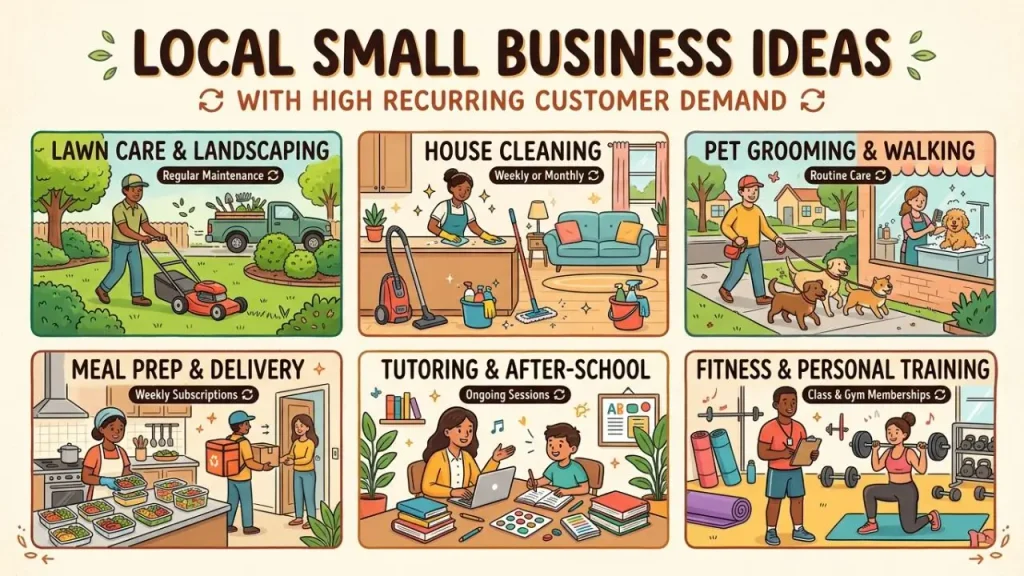
Local businesses have a distinct advantage: they can serve a specific geographic area and build personal relationships with their customers. Examples include mobile car detailing, lawn care, pest control, minor renovations, moving assistance, or local repair services.
Such businesses often benefit from the fact that customers prefer not to spend a long time searching for a provider. When someone needs urgent help, availability, reliability, and clear communication are highly valued. A small business can even have an edge over a large corporation here, as decisions can be made more quickly.
Mobile Services
Mobile business models are particularly appealing because the customer does not necessarily have to visit a physical store. Mobile car detailing, for instance, can be performed right at the customer’s location. Bicycle repairs, certain beauty treatments, or minor technical services can also be offered as mobile services under the right conditions.
This can potentially save on the costs of a permanent storefront. At the same time, logistics must be well-organized; travel time, fuel, materials, and scheduling must all be factored into pricing. A low-revenue job can become unprofitable if it requires a long drive to reach the customer.
Repair and Maintenance
Repair services can offer a strong business opportunity because people often prefer to have an item repaired rather than immediately buying a replacement. This applies to items such as bicycles, furniture, appliances, or certain technical products.
Anyone working in this field should be aware of the limits of their expertise. Specific qualifications and legal requirements may apply to work involving electrical systems, gas lines, or other safety-critical tasks. Professionalism therefore also means declining jobs that fall outside one’s own area of competence.
5. Turning a Business Idea into a Viable Company

An interesting idea is just the beginning. The next step is to determine whether enough people are actually willing to pay for it. You do not need a complex market study for this initially; conversations with potential customers, small-scale tests, and realistic calculations can provide a wealth of important information.
A simple test might involve offering the service to a small group first. When doing so, you shouldn’t just ask if people think the idea is “good.” It is far more telling to see if they are actually willing to spend money on it. There is a significant difference between expressing approval and having a genuine intent to purchase.
Calculating Costs and Prices Correctly
Many new entrepreneurs focus too heavily on revenue and overlook expenses. Calculations should take into account materials, labor time, transport, packaging, software, insurance, fees, and other ongoing costs. Your own time also has economic value.
A simple price comparison with existing providers can be helpful, but it shouldn’t lead you to automatically offer the lowest price. While a low price might attract customers in the short term, it can cause problems in the long run. If revenue does not sufficiently cover actual costs, the business will not grow sustainably, even if the number of orders increases.
Start Small and Grow in a Controlled Manner
A small business does not have to be perfect from day one. A limited initial offering can actually be an advantage, as it makes it easier to identify the services customers truly need. Once a specific offering is running reliably, additional products or services can be introduced.
Growth should not be confused with simply securing the highest possible volume of orders. Rapid growth can harm a business if quality drops, deadlines are missed, or customer service suffers. A more sustainable approach is to stabilize processes first and then gradually serve more customers.
Conclusion
The best small business ideas are not necessarily the most unusual ones. Often, the greatest potential lies in a simple service, an existing skill, or an everyday problem that has not yet been effectively solved.
Anyone looking to start a small business should therefore first consider their own skills, available capital, and the needs of potential customers. Services can offer a relatively easy entry point, while product-based businesses and local offerings present different opportunities.
Ultimately, a successful business idea is not born of creativity alone. It requires customers, realistic pricing, reliable operations, and a willingness to learn from experience. Starting small, knowing your costs, and focusing on the actual value delivered to customers creates a much stronger foundation for a lasting business.
Frequently Asked Questions About Small Business Ideas
1. Which small business ideas are suitable for beginners?
Services such as cleaning, tutoring, gardening, pet sitting, mobile car detailing, or simple creative services can be appealing to beginners. Business models requiring only manageable initial investments are particularly suitable.
2. Can you start a small business with little money?
Yes. Some business models require only a few basic materials or tools. Service-based businesses are often easier to launch on a small budget because there is no need to build up a large inventory.
3. Which business idea is particularly profitable?
That depends on location, demand, skills, pricing, and costs. There is no single “universally profitable” idea. A business can be particularly attractive if it solves a common problem while allowing for sufficiently high profit margins.
4. Should you test a business idea first?
Yes. A small-scale test can reveal whether potential customers are actually willing to pay for the offering. This helps reduce the risk associated with a larger initial investment.
5. Are services better than selling products?
Not necessarily. Services often have lower startup costs, whereas products can offer greater scalability. The right choice depends on the entrepreneur’s skills, resources, and goals.
6. Which local business ideas can generate a steady stream of customers?
Cleaning, gardening, car care, repairs, pet sitting, and certain maintenance services can generate recurring demand. Services that customers need on an ongoing basis are particularly attractive.
7. How do you set the price for a service?
You should take into account material costs, labor time, travel expenses, overhead costs, and your desired profit margin. Additionally, comparing your offering with similar services can help determine a realistic price range.
8. Can you start a small business alongside a full-time job?
Many business models allow you to start on a part-time basis. For instance, services and certain online or home-based businesses can initially be tested with just a few customers. In doing so, it is important to comply with relevant labor, tax, and trade regulations.
9. What makes a small business idea successful?
A good idea solves a genuine problem, reaches a suitable target audience, and can be offered at a price that covers costs while generating a reasonable profit. Reliability and good customer service also play a major role.
10. When should a small business grow?
Growth makes sense when there is demand and existing operations are running reliably. Ideally, you should only expand—whether by hiring new staff, adding services, or increasing capacity—once the business can afford the additional costs.