

Building a company involves making numerous decisions. Beyond products, customers, and finances, entrepreneurs must also review contracts, comply with legal regulations, and avoid potential conflicts. A seemingly minor error in an agreement can lead to significant costs down the line. This is precisely where a business lawyer can help: they assist companies with legal matters, protect their interests, and help them make informed business decisions.
A business lawyer is an attorney specializing in corporate legal affairs. Their scope of work ranges from company formation and contract negotiations to business disputes. Depending on their area of expertise and the applicable legal jurisdiction, they may also provide advice on mergers, acquisitions, employment matters, or intellectual property issues.
In addition to legal matters, entrepreneurs should also understand the fundamentals of their business in order to better assess financial obligations and important business decisions.
Not every company requires a lawyer on a constant basis. Nevertheless, timely advice can be crucial when major investments are pending, new business partners are brought on board, or legal uncertainties arise. Understanding the role of a business lawyer helps entrepreneurs better assess when professional support makes sense and what to look for when selecting a suitable attorney.
1. What is a business lawyer, and what tasks do they perform?
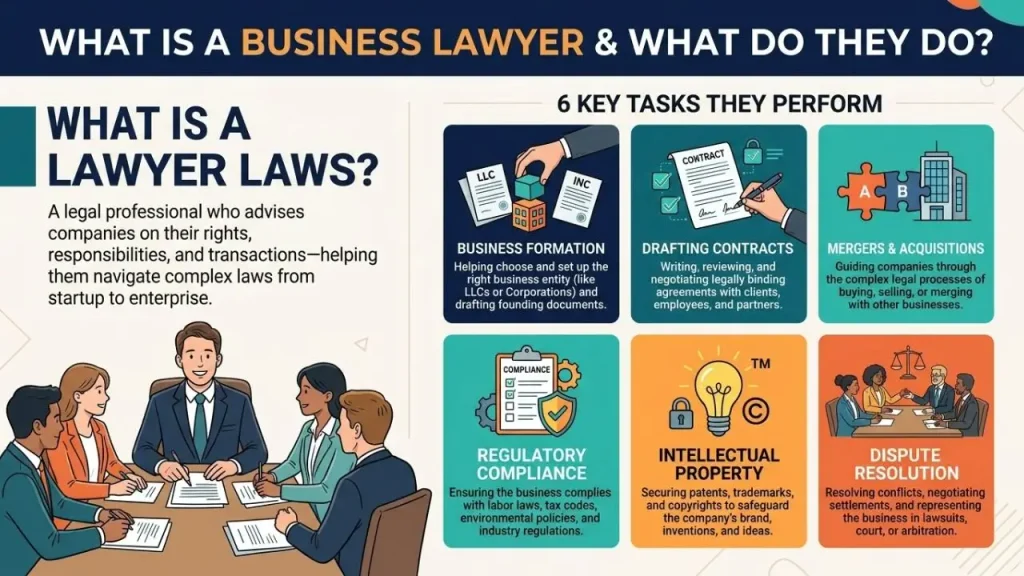
A business lawyer (often referred to in German as an *Unternehmensanwalt* or *Wirtschaftsanwalt*) advises companies on legal matters affecting their business operations. They help clients understand legal requirements, draft legally sound agreements, and identify risks at an early stage. Their work can encompass advisory services, contract drafting, and dispute resolution.
Specific tasks depend on the company’s size, its industry, and the particular mandate. A self-employed tradesperson might need assistance with customer contracts and payment claims. In contrast, a growing technology company might need to deal with software licenses, data protection, investment agreements, and the protection of its proprietary developments. A business lawyer tailors their advice to the specific needs of the business in question.
Legal advice in day-to-day business
Many legal issues arise during normal business operations rather than in a courtroom. Companies enter into supply contracts, hire employees, engage service providers, and agree on payment terms with customers. Each of these relationships can entail legal obligations.
A business lawyer can review such processes and help establish clear rules. For instance, they examine the agreed-upon services, payment due dates, and the consequences should a party fail to fulfill its obligations. Well-drafted contracts reduce the risk of mismatched expectations and facilitate the resolution of future disagreements.
Furthermore, a business lawyer can explain the legal obligations that company executives must observe. Depending on the country, these may include corporate law, labor law, consumer protection, and data protection regulations. Since regulations vary between countries—and sometimes even between regions—advice must be tailored to the applicable legal framework.
Support for Key Business Decisions
Entrepreneurs regularly make decisions that can have long-term financial consequences. Examples include bringing on an investor, opening an additional location, or entering into a strategic partnership. A business lawyer assesses the legal aspects of these moves and highlights potential obligations.
Consider a small business looking to bring on a business partner. Beyond the question of how much capital the partner will contribute, the parties involved must clarify who has decision-making authority, how profits will be distributed, and what happens in the event of a split. A carefully drafted partnership agreement can help settle these matters in advance.
A lawyer does not automatically decide which business strategy is best. Instead, their role is to explain legal risks clearly and outline potential solutions. This enables management to better assess economic opportunities and make decisions based on a more reliable foundation.
2. When Does a Company Need a Business Lawyer?
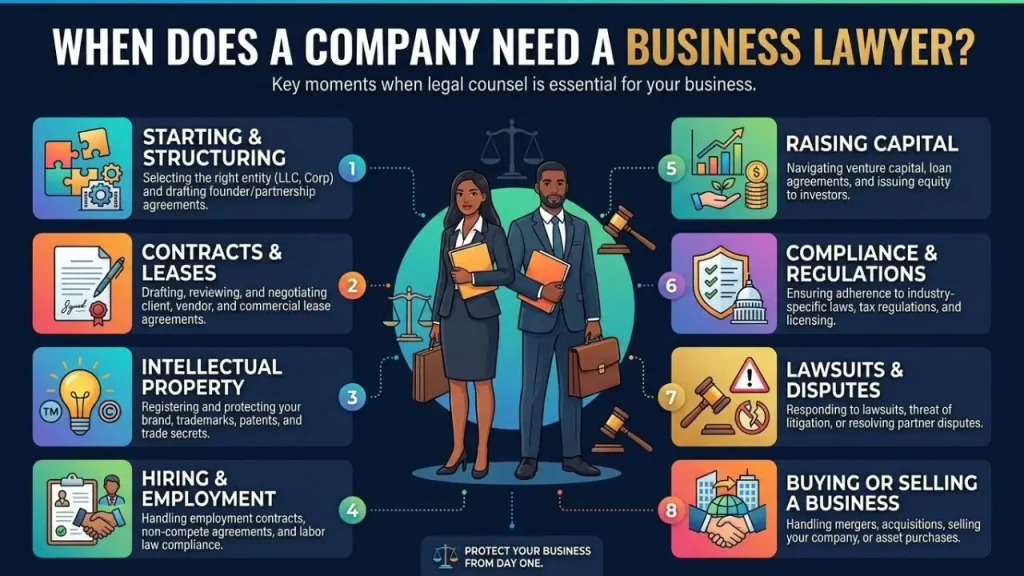
A company should not wait until a dispute has already arisen to seek legal support. Early review can be particularly beneficial during major changes or when entering into important agreements. This makes it possible to identify problematic contract clauses, unclear areas of responsibility, or unexpected obligations before they escalate into costly problems.
The right time depends on the specific situation. A small business with few client contracts has different needs than a company that trades internationally or is planning significant investments. The deciding factor is not merely the size of the company, but also the complexity of the legal issues and the potential consequences of an error.
Anyone wishing How to start a small business should consider the appropriate legal form, potential liability risks, and necessary business agreements at an early stage.
Starting a Business
Several fundamental questions must be addressed even before the business is launched. These include selecting a suitable legal form, determining ownership structures, and deciding who is authorized to represent the company. The chosen structure can impact liability, taxation, administration, and future financing options.
A business lawyer can explain the legal distinctions between potential business forms and assist with the necessary documentation. If multiple founders are involved, it is also important to establish how decisions will be made, what roles each party will assume, and how conflicts will be resolved.
Not every business launch requires extensive legal counsel. For simple, low-risk operations, limited advisory services may suffice initially. However, once multiple partners, significant financial obligations, or complex licensing issues are involved, professional support becomes particularly valuable.
Handling Conflicts and Legal Claims
Disputes can arise when a customer fails to pay an invoice, a business partner does not honor their commitments, or a contracting party asserts a claim for damages. Disagreements between shareholders can also significantly disrupt business operations.
A business lawyer begins by reviewing the relevant documentation, contractual obligations, and the legal situation. They can then outline potential courses of action, such as negotiations, an out-of-court settlement, formal mediation or arbitration proceedings, or—if necessary—litigation.
Not every conflict needs to end up in court. Constructive negotiation can save time and money while preserving the business relationship. If a settlement cannot be reached, the lawyer can explain the available legal options and assist the company in enforcing or defending its claims.
3. What legal areas does a business lawyer cover?

Business law encompasses numerous specialized fields. Some business lawyers maintain a broad practice, advising primarily small and medium-sized enterprises. Others focus on specific areas, such as corporate acquisitions, labor law, or intellectual property. Therefore, before engaging a lawyer, it is advisable to clarify whether they possess the necessary experience for the specific matter at hand.
Legal needs may also evolve as a company develops. While the initial phase might focus on incorporation and early customer contracts, issues such as employment relationships, financing, data protection, or international business relations gain importance later on. A suitable legal advisor helps navigate these changes from a legal perspective.
The SBA explains that companies must fulfill various legal and internal obligations depending on their legal form and location.
Contract Law and Corporate Law
Contract law deals with agreements between companies, customers, suppliers, and other business partners. A business lawyer can draft contracts, review existing documents, and assist with negotiations. In doing so, they ensure that deliverables, deadlines, payment terms, and responsibilities are defined as clearly as possible.
Corporate law, on the other hand, concerns the legal structure of a company. This includes, for example, the incorporation of the company, the rights of shareholders, and the responsibilities of management. Legal advice may also be required when changes to ownership structures are planned.
A practical example is the sale of company shares. In addition to the agreed purchase price, the parties involved must clarify—among other things—which rights are being transferred, which warranties apply, and whether specific approvals are required. The precise structuring depends on the legal form of the company and applicable regulations.
Labor Law and Employment Relationships
As soon as a company employs staff, additional legal obligations arise. These may concern employment contracts, remuneration, working hours, vacation entitlements, termination of employment, and the handling of confidential information. The applicable regulations depend on the specific country and, where relevant, on collective bargaining agreements or specific industry regulations.
A business lawyer experienced in labor law can assist employers in drafting appropriate contract terms and reviewing personnel decisions from a legal standpoint. This is particularly helpful, for instance, when an employee challenges a termination or when there is ambiguity regarding contractual obligations.
Seeking advice can also be beneficial when introducing new working models. For example, companies should have the requirements for remote work, the handling of corporate data, and the termination of employment relationships reviewed. A timely review can help prevent misunderstandings and ensure that the interests of both parties are appropriately taken into account.
Labor Law and Employment Relationships
As soon as a company employs staff, additional legal obligations arise. These may concern employment contracts, remuneration, working hours, vacation entitlements, termination of employment, and the handling of confidential information. The applicable regulations depend on the specific country and, where relevant, on collective bargaining agreements or specific industry regulations.
A business lawyer experienced in labor law can assist employers in drafting appropriate contract terms and reviewing personnel decisions from a legal standpoint. This is particularly helpful, for instance, when an employee challenges a termination or when there is ambiguity regarding contractual obligations.
Seeking advice can also be beneficial when introducing new working models. For example, companies should have the requirements for remote work, the handling of corporate data, and the termination of employment relationships reviewed. A timely review can help prevent misunderstandings and ensure that the interests of both parties are appropriately taken into account.
4. How do you find the right business lawyer?

Choosing a business lawyer should not depend solely on price or the size of the law firm. It is far more important that the lawyer understands the specific issue at hand, has experience with comparable cases, and can explain legal options in understandable terms. Successful collaboration also requires that expectations, costs, and communication channels be clearly defined from the outset.
Before engaging a lawyer, business owners should consider exactly what kind of support they need. If the matter involves a single contract, a clearly defined, limited mandate may suffice. However, a corporate acquisition or a major legal dispute might require a team with expertise in multiple areas of law. Being able to describe the matter precisely makes it easier to find a suitable lawyer.
Checking experience and specialization
A lawyer who regularly assists small businesses with contract issues may be a good fit for a local service provider. Conversely, a company planning an international acquisition might require expertise in corporate law, transactions, and cross-border trade.
During an initial consultation, you should ask about comparable mandates, relevant expertise, and the proposed course of action. The goal is not to obtain confidential information about other clients; rather, the lawyer should be able to explain their general approach to handling similar legal issues.
Equally important is admission to practice law in the relevant jurisdiction. Businesses operating in multiple countries should clarify whether additional local counsel is required, as a lawyer cannot automatically provide authoritative assessments on legal matters in other countries.
Understanding Costs and Billing
The cost of a business lawyer can vary significantly depending on location, experience, area of expertise, and the complexity of the matter. Some lawyers bill by the hour, while others offer a fixed price for clearly defined tasks. For extensive projects, other agreed-upon fee structures may also be an option, provided they are legally permissible.
Before work begins, it should be clarified in writing which services are included, what additional costs might arise, and how progress updates will be handled. For instance, when drafting a contract, one should ask whether revisions based on feedback are included or billed separately.
A low hourly rate does not necessarily result in the most cost-effective overall solution. If a lawyer completes a task efficiently and identifies risks early on, this can prevent future expenses. Conversely, one should not automatically assume that a more expensive law firm will deliver better results; transparency and relevant experience are more important factors.
Communication and Trust
Legal matters often involve uncertainty. Therefore, a business lawyer should be able to explain complex issues in language that is understandable even without legal training. They should clearly outline which aspects are secure, where uncertainties exist, and which decisions rest with the client.
Before engaging a lawyer, it is worth discussing preferred communication channels, expected response times, and the designated point of contact. Especially in urgent business matters, knowing the typical turnaround time for a response and who is available in the lawyer’s absence is helpful.
Trust does not mean the lawyer must promise every desired outcome. Professional advice may also involve highlighting risks or advising against a particular course of action. Honest assessments are more valuable in the long run than unrealistic assurances.
5. What benefits does a business lawyer offer to small and large companies?